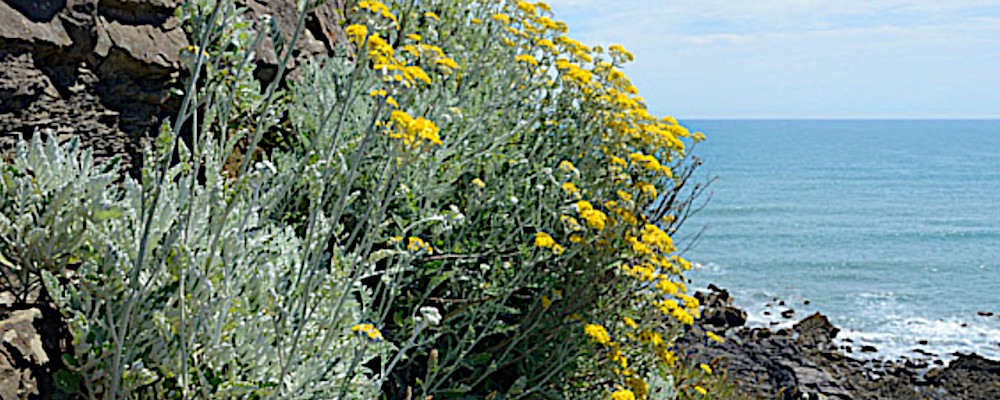
You might know this plant as Senecio maritima, or even some other names. Since the time of my story about Mr. Kovac’s dusty miller, this has continued to be a common landscape plant here in California (and elsewhere). There are many cultivars, some new forms introduced periodically, but ultimately they are all the same in habit and growth.
Offered as a contrast to green foliage or to provide a ‘cooling’ respite from hot colored bedding flowers, I see it routinely in local gardens. It is often planted in too much shade, which make the growth open, lax, more untidy.
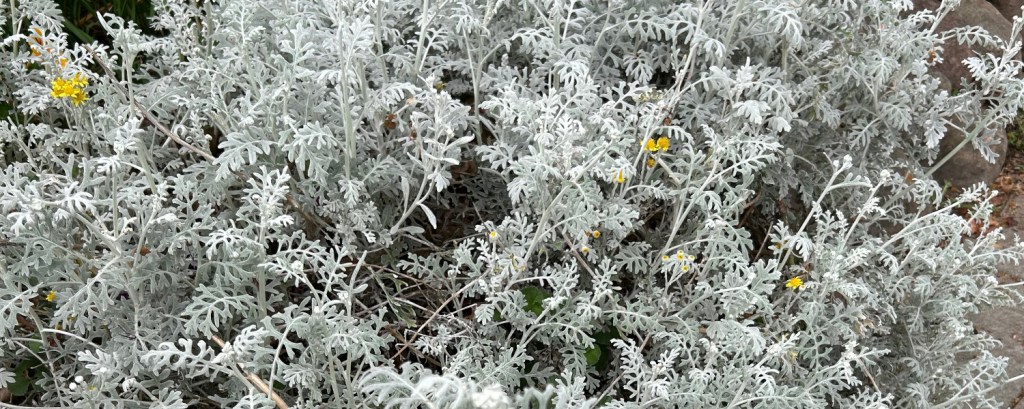
Planted in this way, in rich soil and with regular irrigation, the plant becomes quite messy very quickly, requiring putting back or replacement. This species is also know for self-seeding and can start ‘popping up’ in unexpected places, further violating the intentions of the gardener.
Though not a favorite plant of mine, it has its uses. Towards understand that, years ago, I was somewhat surprised to see this species in one of its native haunts in the South of France, growing on a limestone promontory!

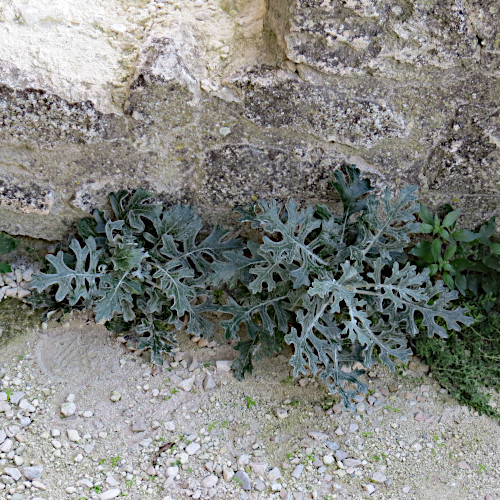
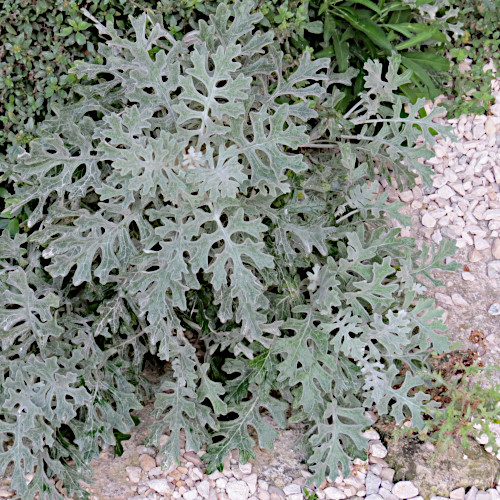
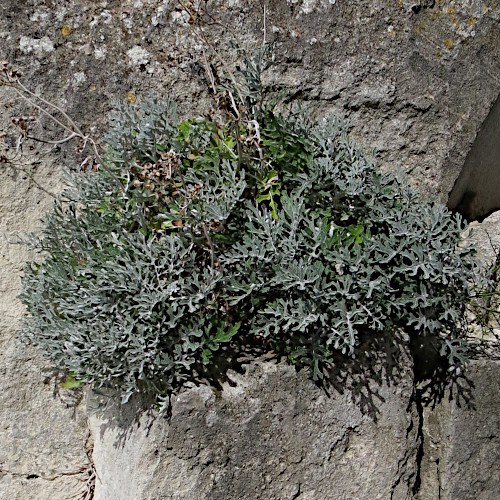
The compact habit and intensity of the gray foliage in response to the rigorous conditions demonstrated the best use of this plant. Like many other gray leafed species around the Mediterranean basin, it was well adapted to this spartan environment. It clearly will grow in a ‘cushy’ garden bed or a carefully curated potted arrangement, but it will never show its true form under those conditions.
A (kinda) Brief Botany Break
Jacobaea maritima (L.) Pelser & Meijden. – Fl. Nederland: 677 (2005)
ya-ko-BYE-ah mar-RRRIH-tih-mah (pronunciation info)
Synonyms
Cineraria acanthifolia Rchb. in Iconogr. Bot. Exot.: 17 (1824)
Cineraria calvescens Nyman in Syll. Fl. Eur., Suppl.: 1 (1865)
Cineraria ceratophylla Ten. in Index Seminum (NAP, Neapolitano) 1825: 3 (1825), nom. nud.
Cineraria maritima candidissima Van Houtte in Nursery Cat. (Louis van Houtte) 177: 123 (1878-1879 publ. 1878)
Jacobaea tomentosa Moench in Methodus: 587 (1794)
Leucoseris maritimus Fourr. in Ann. Soc. Linn. Lyon, sér. 2, 16: 404 (1868)
Senecio acanthifolius (Rchb.) Kostel. in Allg. Med.-Pharm. Fl. 2: 714 (1833)
Senecio bicolor var. plattii (Meikle) V.A.Matthews in Notes Roy. Bot. Gard. Edinburgh 33: 434 (1975)
Senecio borysthenius Andrz. ex DC. in Prodr. 6: 351 (1838)
Senecio chrysanthemifolius Moretti in Bibliot. Ital. (Milan) 12: 374 (1818)
Senecio cineraria var. plattii Meikle in Kew Bull. 1954: 142 (1954)
Senecio erucifolius Kunze in Flora 29: 655 (1846), nom. illeg.
Senecio ginesii Cuatrec. in Bull. Soc. Bot. France 101: 245 (1954)
Senecio jacobaea Kunze in Flora 29: 676 (1846), sensu auct.
This plant is quite common in cultivation, as are the many cultivars, so I don’t feel it necessary to go repeat that information here. It seems to be one of the most common ‘dusty miller’s in the worldwide trade, so you will likely find it easily at a nursery or online.
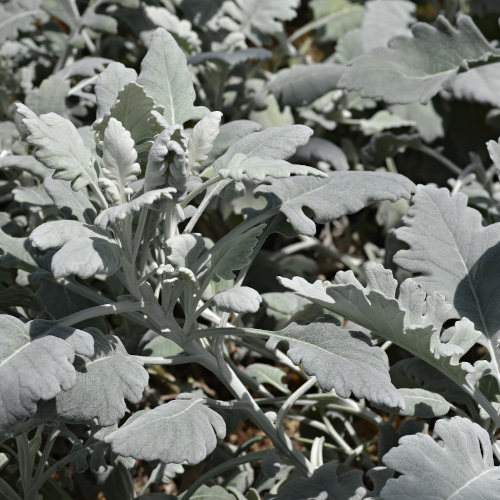
Be that as it may, keep in mind that this plant is often confused with various other gray-leafed plants such as Centaurea cineraria, C. ragusina, Senecio viravira, etc. To see similar plants to this species, see Comparative Centaureas (on this blog).
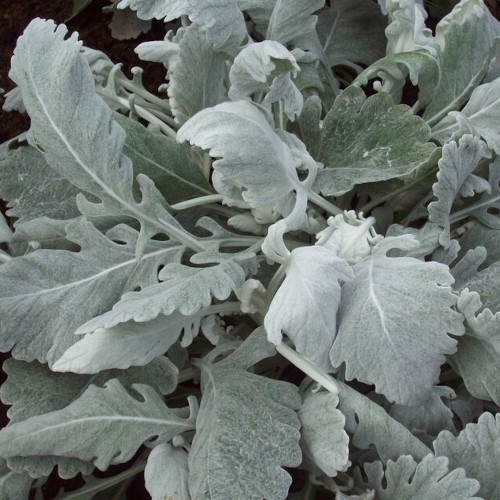
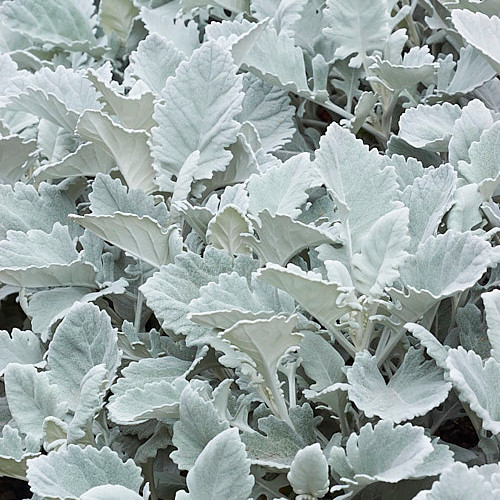
One of the forms of J. maritima, cultivar ‘Cirrus’, is sometimes confused with the rare species Centaurea ragusina, because of its relatively more ‘entire’ leaf shape. Since this is a common the most form in today’s florist trade, I thought it worth a mention.
Resources & Links
(*Information retrieval date for the URL mentioned)
Mr. Kovac’s dusty miller PART I (a post on this blog)
Difference Between Jacobaea maritima and Centaurea cineraria. Plants, People, Places. https://plantspeopleplaces.com/difference-between-jacobaea-maritima-and-centaurea-cineraria/ (*May 2025)
Centaurea ragusina. https://gimcw.org/2024/09/14/centaurea-ragusina/ (a post on this blog)
 gardening in mediterranean climates worldwide