PART I
At 16, I was happy to have this job at a local nursery, hoping I would learn a lot. But it turned out that my duties largely just watering plant and lugging bags of soil to customer’s cars. But on this particularly warm day I was glad to be under the shade cloth soaking the pots.
Out of the corner of my eye, I noticed a customer enter the nursery. It was Mr. Kovac, our local watch repair man, and he was wearing his usual button-down shirt and bow tie. He was tall and lanky and exhibited another usual trait – putting his hands-on-hips when he was trying to sort something out, which I felt always exaggerated his skinny frame. He looked a bit lost in this environment.
Because I was told by my boss not to interact with customers, I continued directing my watering wand from pot to pot. Suddenly I heard, at close range, Mr. Kovac address me directly: “Hi Sean. I didn’t know you worked here! Do you know where where I could find the ‘dusty millers’?” Setting down my watering wand I replied “Sure”, and led him over to the ‘six-pak’ table on the other side of the nursery. I pointed at a few gray leafed plants with a pink label announcing ‘DUSTY MILLER’ in bold letters (this was 1970 and few of the plants in the nursery had labels at all, and if they did, it was only a common name or even just a ‘cultivar’ without the Latin name).
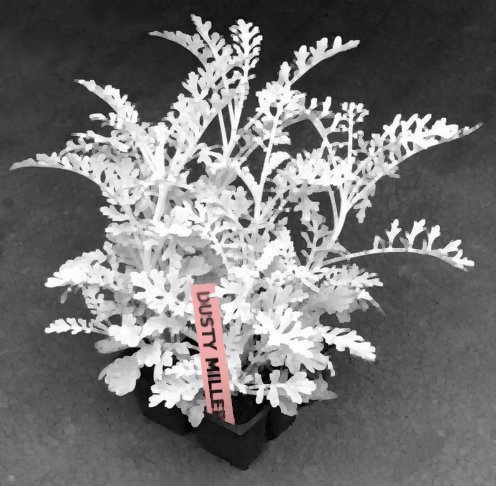
“But that’s not the right one!” Immediately I realized that these plants were not the same ones I had seen there before, but I all I could think to say was “I think these are the only ones we have today.”
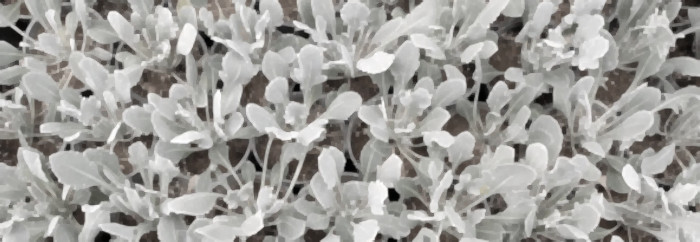
After returning to my watering duties, I later saw Mr. Kovac back at the ‘dusty millers’ with my boss. Now they both stood there with hands-on-hips as they talked about the plants. Mr. Kovac soon left, empty-handed and obviously unhappy. Later that day, when I was watering that area, I took a closer look at these plants myself. While they had the same bright gray foliage, they did look very different from those I’d watered weeks before.
As I rode my bicycle home that evening, I found myself, perhaps intuitively, riding down the street where I knew the Kovacs lived. I spotted the house easily – at the curb was an overfull garbage can with long stems terminating in clusters of white leaves. I stopped to examine the landscape in front of the house: A neatly trimmed band of junipers formed the perimeter on three sides. Red lava rock mulch studded with white-leafed Dusty Millers formed the next banding. A square of turf completed the middle. Just the sort of garden I might have imagined Mr. Kovac might have!
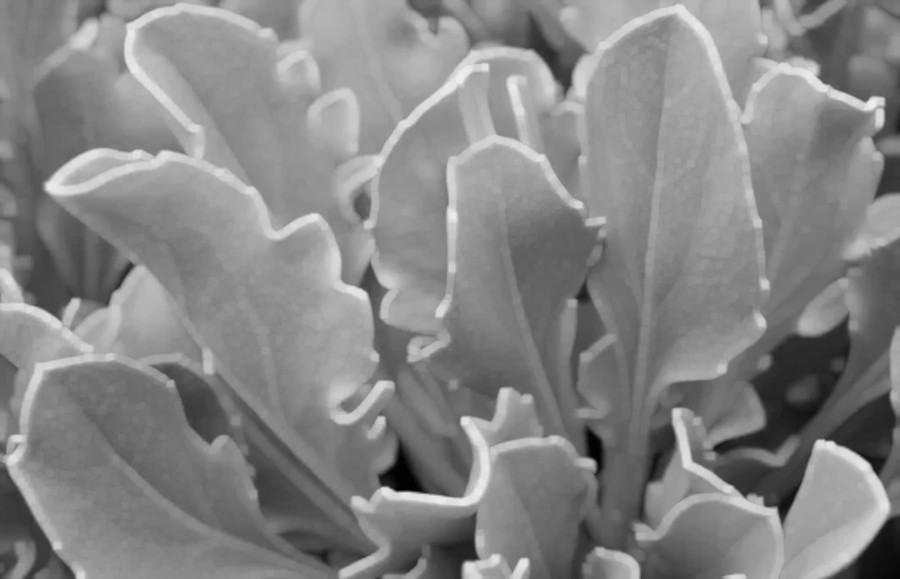
I examined the remaining Dusty Millers in this garden, I could see why Mr. Kovac was in the nursery that morning, and why he was frustrated – the leaves on his plants looked very different from those we currently offered at the nursery. Most of the plants seemed to be quite old, with long, leggy stems incapable of holding erect their tuft of a few leaves (certainly not appropriate to the extreme ‘tidiness’ of the planting scheme). I turned my attention back to the trash can, obviously containing the worst specimens that had been ripped out of the garden. Some had yellow thistle-like fading flowers.
Then I got an idea. I parked my bike and rang the front doorbell. After a few tries, I gave up as there was no response. Returning to the trash can, I collected pieces of the best looking discarded plants, placed them in my bicycle basket, and rode home. I thought the limp plants could use some water, so I made cuttings from the leafy tips, found some old canning jars in our family garage, filled them with water and inserted the plants. The next day, I was pleased to see that they were looking perky and much more healthy.
I had recently learned how to ‘strike’ (root) cuttings and purchased a small jar of rooting hormone from the nursery a few weeks before. It seemed Mr. Kovac’s plants would make a good experiment. I returned to the library where I had found instructions for ‘striking cuttings’ and studied them carefully. I was excited to handle this plant material and examine them at close range. Their suede-like felty covering seemed to want to pull away too much tissue as I removed excess leaves, so I had to be careful. I now had dozens of potted cuttings which I placed in a shady part of the yard.
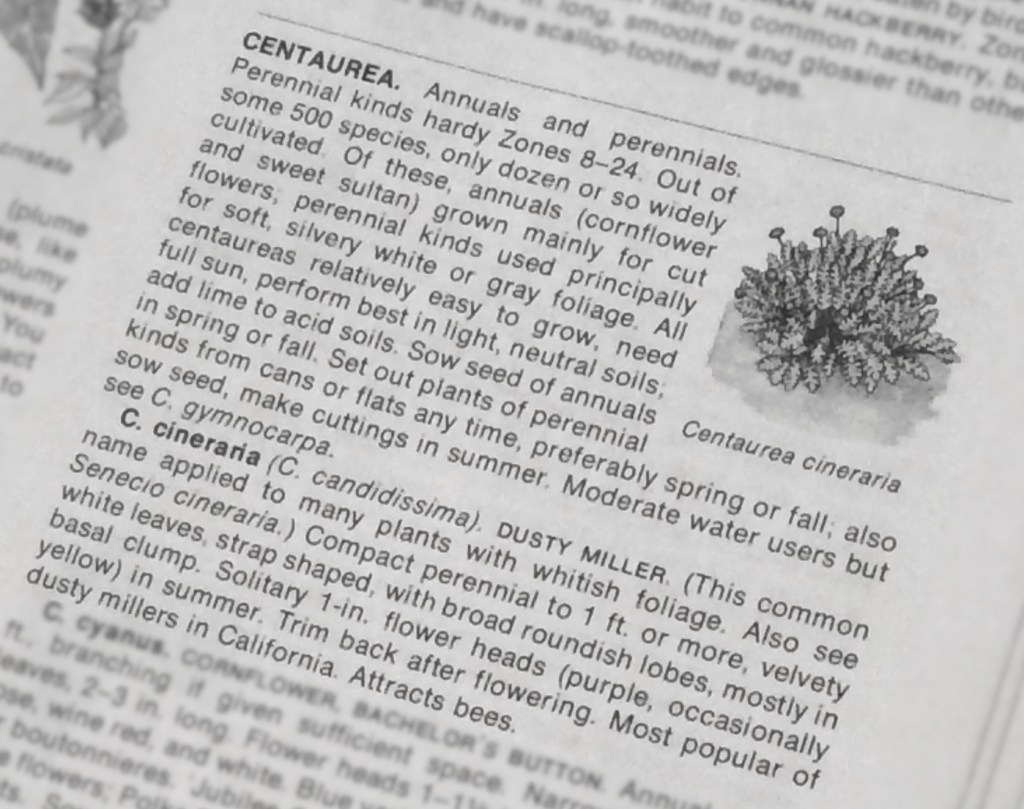
My trusty Sunset Western Garden Book listed a number of plants with the common name of dusty miller. The plant most closely matching what grew in the Kovacs’ front garden seemed to be Centaurea cineraria. The illustration and description were surprisingly vague:
I was surprised at how quickly the cuttings rooted. Such success with my first significant propagation attempt! I carefully tended the new plants over the next few weeks.
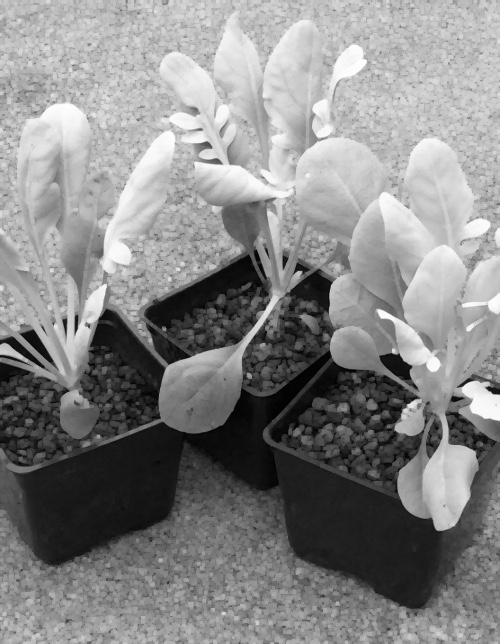
One day on the way to my job at the nursery, when the cuttings seemed well rooted, I strapped a large box to the back rack of my bike, and loaded it with as many plants as it would hold. Using my bike as transport for the plants, the handful of blocks to the Kovacs’ house.
I rang the doorbell. This time, Mrs. Kovac answered the door in brightly printed apron, wiping her hands with a dish towel of equal flowery brightness. After she explaining to me that her husband was not home, I told her that I just wanted to leave some plants for him. As I brought the box of rooted cuttings up to the front porch, her evident surprise was quickly replaced by a big smile. “Oh my goodness! Ronnie will be so pleased! He’s been so upset about those plants.” When faced with her excitement, my innate shyness made me suddenly uncomfortable. I swallowed hard and just replied “Good. Bye now!” and promptly left for the nursery. In my retreat, I could hear her start a reply “But …”
After my shift at the nursery, I returned home via a more direct route which didn’t include passing the Kovacs’ house. As I parked my bike in the back yard, my Dad came out to meet me. “I’ve had the strangest call from Ron Kovac – in the most friendly tone I’ve ever experienced from him. You are invited to their Sunday dinner tomorrow! What’s going on?”
Where/when I grew up, Sunday dinners were still a significant, somewhat formal event. My mother made sure that I wore some of my better clothes. As I arrived a the Kovacs’ address, I noticed that some of the plants I had brought them were already planted in the simple, geometric front yard. The Kovacs both greeted me excitedly at their front door.
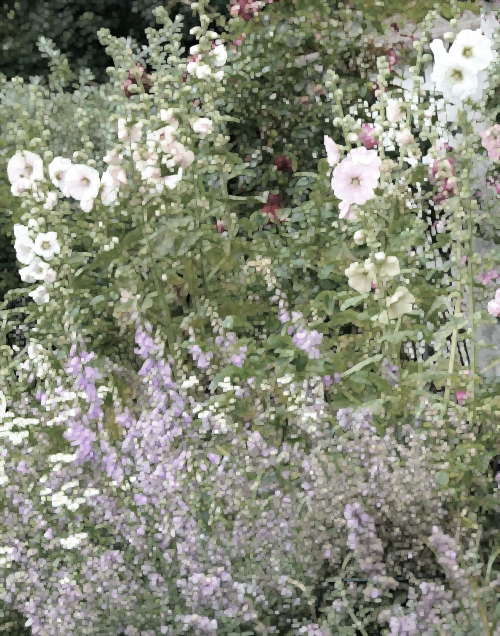
As I entered their home, through the large living room window I could see that apparently the entire back yard was a tumble of floral abundance. In response to my gawking stare, Mrs. Kovac offered “Ronnie would prefer that I keep my flowers more orderly, but I just love a garden going its own way!”
Mr. Kovac smiled quietly.
We dined on a simple meal of roast beef, carrots, and jello salad. During dinner, Mr. Kovac questioned extensively me about how I’d raised the dusty miller plants, how I learned to do such things, could I teach him how to do it. As I answered his queries, he listened with great interest and even took notes on a pad he brought to the table! Occasionally Mrs. Kovac would interject personal questions about the health of my family, my father’s newest job, my older brother studying for the priesthood. It was all I could do to keep up these two modes of interrogation.
Finally, I had a question of my own: “Mr. Kovac, why are these dusty millers so important to you, and not the ones we now sell in the nursery?” I was surprised to see his intent expression suddenly become inscrutable. Silently, he was apparently overtaken by a sudden need to clear some of the dishes, disappearing into the kitchen.
Sensing my embarrassment, Maria Kovac touched my hand and explained: “Don’t worry, Ronnie finds it hard to answer your question because his mother, Ena, died three months ago. Years ago, she visited us here in California. Always a gardener, she was interested to see your nursery as we drove her around. As we wandered your nursery, she came across a plant that caused her to stop. Ena had tears in her eyes when she said ‘Moya mala zeh-see-nahs!!!’ She told us that these were a plant from her childhood home in Istria and had always remained her favorite. She had not seen them since coming to the US decades before.”
These plants were purchased and were planted in the Kovacs’ front garden. Years later, Mr. Kovac came looking for replacements at ‘my‘ nursery.
When Mr Kovac finally returned from the kitchen, I produced my small jar of rooting hormone (half empty) and said it was for him. He excitedly read the information on the container. As I left, we stopped to inspect his replanting effort. Maria gave me a big hug, Mr. Kovac shook my hand firmly in a manner I knew represented respect.
This event underscored for me the emotional connection people have with their gardens. PART II of this story outlines how I came to learn that the identify Mr. Kovac’s plants had been confused by gardeners for decades (and was in fact NOT C. cineraria), and it was only years later that I realized the ‘clues’ dropped by the Kovacs regarding this … (see PART II)
Resources & Links
(*Information retrieval date for the URL mentioned)
Sunset Western Garden Book, 1935-2001, www.sunset.com/marketplace/sunset-western-garden-book-timeline, (*October, 2004)
 gardening in mediterranean climates worldwide