
While I was trying to track down the real identity of Mr. Kovac’s dusty miller, I found information about other Centaurea species with gray leaves. Using various libraries I had at hand (this was pre-Internet 1980), or those I happened to find in other towns, I regularly came across a handful of other species that were similar.
One particular plant caught me attention as it was becoming more common in our local SF Bay Area gardens. I recalled what was mentioned in my copy of the Sunset Western Garden Book:
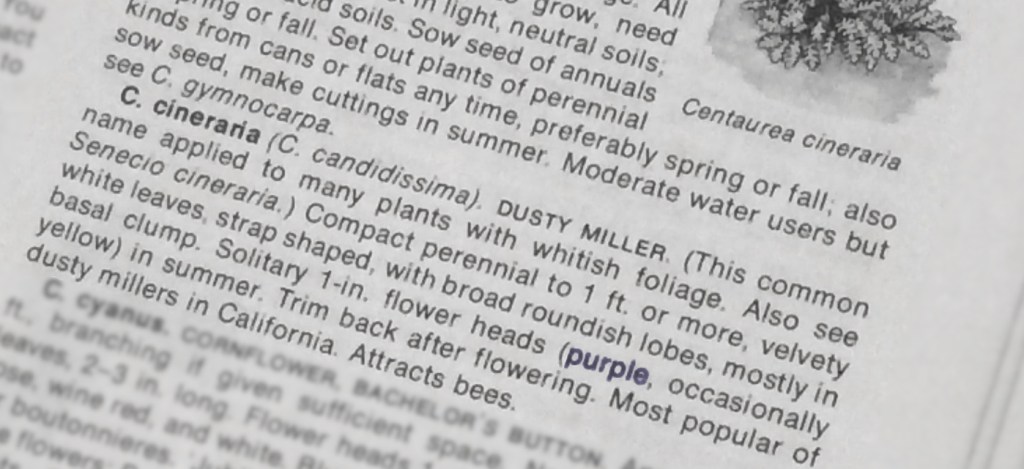
Now this plant did have purple flowers, but was otherwise quite different – more finely dissected leaves, growing quickly into a huge, floppy mound, ultimately topped with lots of rosy-purple ‘bachelor-button-like flowers’. What impressed me is that it grew quickly and so large. It was also easy to propagate from cuttings (there was always more plant than most people desired). It was also popular because when it got too rangy or ‘floppy’, a hard cutting back brought it quickly into a more desirable form.
Research books offered various Latin names of Centaurea acutifolia, C. candidissima, C.cinerea, C. dealbata, C. elegans, C. gymnocarpa, C. plumosa, C. rutifolia, C. ucriae, Acosta cineraria, and even more!! In some cases, I was able to place the plant photos of two books next to each other and see that the same plant was named differently in each – OR obviously (to my eyes) very different plants were labeled as the same species!
I had already started to understand that Centaurea species can have very different leaf shapes as they grow and mature, and this is often repeated seasonally as new growth begins. It seemed possible that some of the photos I was seeing were at different stages of growth, but I was still suspicious.
The first of this purple flowered ‘dusty miller’ I saw locally were pass-along plants – easily rooted cuttings given to neighbors or garden visitors. But gradually nurseries started to stock it as well. The nurseryman’s labeling of Centaurea gymnocarpa provided a simple solution to the confusion of Latin names I had found in my research, so I embraced this identification.
I could not find much information about C. gymnocarpa but it was apparently a rare endemic native to a very tiny island off the coast of Tuscany called Capraia Isola. I found this strange – why would a critically endangered plant from a tiny island off the coast of Italy become an easily grown garden plant in California (and, as my awareness grew, worldwide)? I would inspect each plant I found, learning more about its ‘morphology‘. I looked for seeds on every plant I could, but never found any. I had read that hybrids of separate species often are sterile, seldom producing seeds. Huh. I wonder …
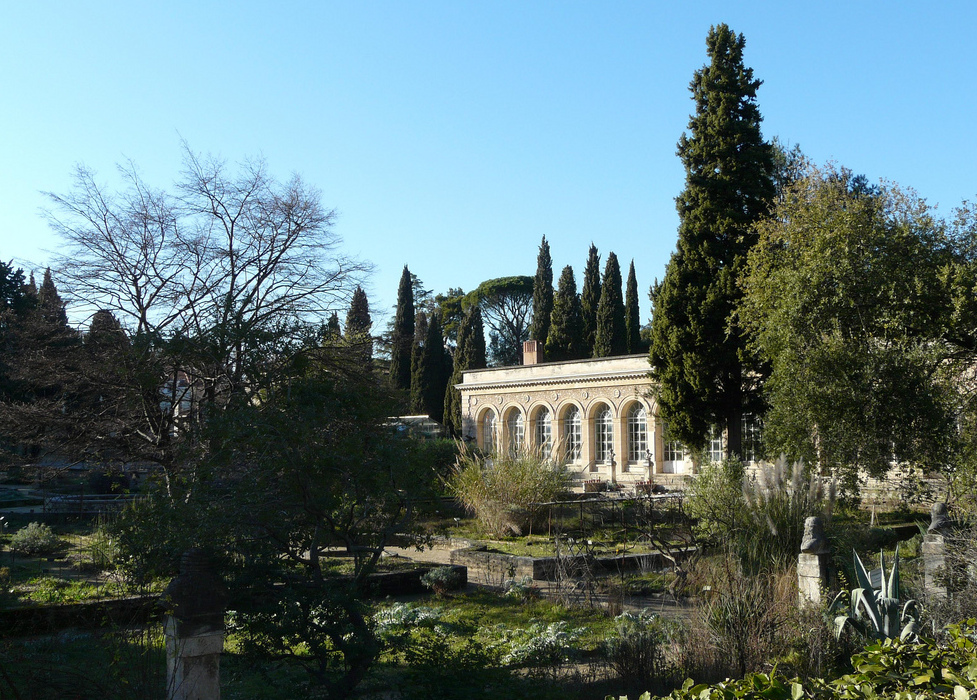
Around this time (2000), we took a trip to France and Italy. While visiting our friend, Olivier Filippi outside of Montpellier, he took me to Le Jardin des Plantes, France’s oldest botanical garden. As part of our visit, we stopped off at the herbarium – one of the oldest continually working institutions of its kind.
Unexpectedly, I was able to inspect a variety of Centaurea specimens, some hundreds of years old! Since I had volunteered in a herbarium in college, I was aware of how to carefully handle specimens, but Olivier was somewhat surprised that I was suddenly handling so many!! (see also That Mysterious Plant on this blog) Our visit had to be cut short but I hoped someday to return to this amazing resource!
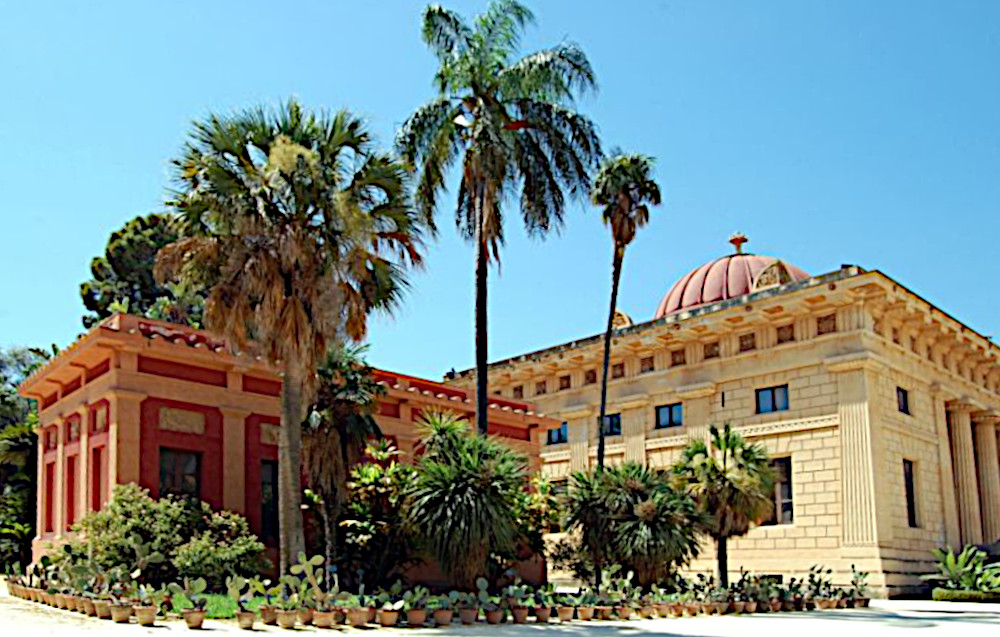
Later, in Italy, we visited the Orto Botanico in Sicily with a group of MGS members. I chanced to have a conversation with one of their botanists – Angelo Troia – about my interest in Italian gray leafed Centaureas. He was not aware of information at the moment, but he promised to look into it.
After we returned home from our travels and returned to our regular routine, I was surprised to receive a manila envelope in the mail from Sicily! It contained a photocopy of a journal article – ‘Centaurea cineraria s.l. (Asteraceae) in Italia, Revisione Citotassonomica’ (Atti Soc. Tosc. Sci. Nat., Mem, Serie B 89 (1982)).

I could not believe it! In this work – in Italian (& scientific Latin) – was found a definitive classification of various gray leafed Centaurea species surrounding Italy. Wow!! While it was tedious translating this document from Italian, but each part I understood gave me motivation to translate more.
As I became aware of the various similar gray leafed Centaurea species that had evolved on the western edge of Italy, I imagined traveling to that coast and islands to see all of them first-hand! Perhaps someday …
In two separate posts – Centaurea cineraria & C. gymnocarpa, I talk about a future visit to France when I able to revisit the herbarium at Le Jardin des Plantes de Montpellier to further explore their collection, focusing primarily on these species.
Because I happened to ‘fall into’ researching one plant that led to doing the same for some similar plants, I have become associated with this group in many people’s minds. But my interests are varied, as my blog demonstrates. Now that I am a septuagenarian, I feel that sharing my experiences and knowledge is more important than ever as I have benefited from others doing the same. I understand that the path I chose to trod is not for everyone, but if even a single person connects with my experiences and find encouragement, then it has been worth all the effort.
References and Links
(*Information retrieval date for the URL mentioned)
Mr. Kovac’s dusty miller PART II (on this blog)
Sunset Western Garden Book, 1935-2001, www.sunset.com/marketplace/sunset-western-garden-book-timeline, (*October, 2004)
Le Jardin des Plantes de Montpellier, facmedecine.umontpellier.fr/jardin-des-plantes/, (*March, 2014)
That Mysterious Plant, (on this blog)
L’Orto Botanico, Palermo, Sicily, www.ortobotanico.unipa.it/ (* March 2025)
Centaurea cineraria s.l. (Asteraceae) in Italia, Revisione Citotassonomica, Atti Soc. Tosc. Sci. Nat., Mem, Serie B 89 (1982), gimcw.org/wp-content/uploads/2025/04/centaurea_cineraria_in_italia.pdf (a PDF document posted to this blog)
 gardening in mediterranean climates worldwide