PART III
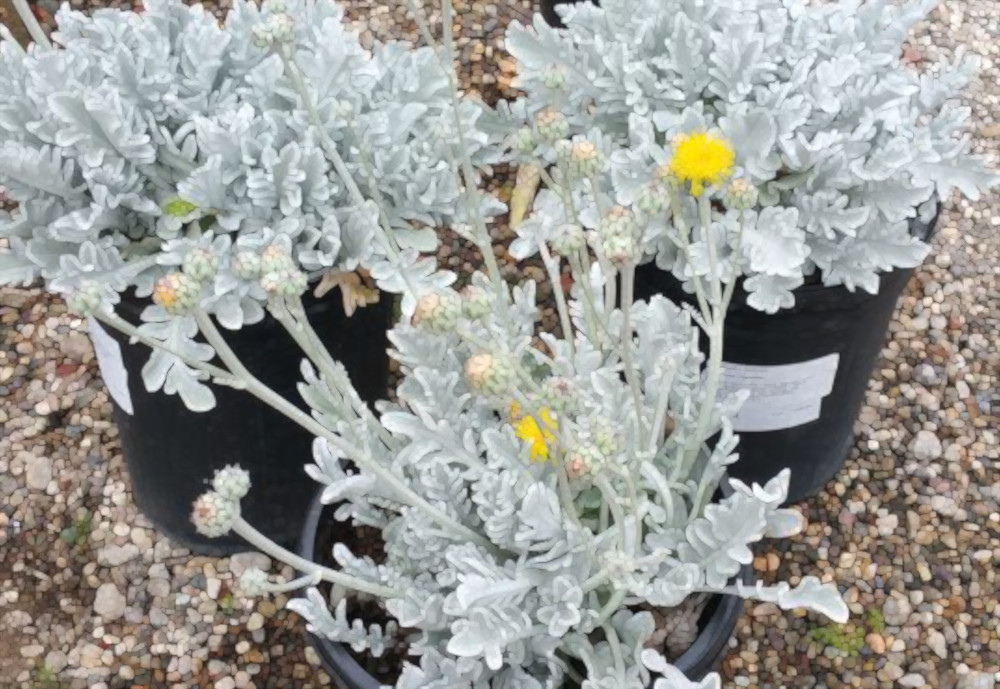
In 2016, I was surprised to be contacted by Randy Baldwin about an old gimcw.org page regarding Centaurea ragusina. His nursery, San Marcos Growers, had apparently become aware of C. ragusina via stock they found at Seaside Gardens, a retail nursery in Carpinteria in Southern California. My reaction was in response to my awareness of Randy and his VERY careful documentation of plants offered by San Marcos Growers (since closed for business):
We first picked up a plant so labeled at Seaside Gardening, a retail nursery in Carpinteria, and this year collected seed from this plant that has germinated well, so potentially we will have a nice crop next year. I also noted the great pictures you have of it on Tumblr and, when first researching this plant last May, I found a page you wrote on the gardening in mediterranean climates worldwide site that discussed the possibility that Centaurea candidissima ‘Magic Silver’ and C. ragusina may be synonymous. When trying to access this page again today the URL now returns a ColdFusion error. [in response, I sent him copies of those pages from my defunct website]
I did see other references to this link between to Centaurea ragusina and C. candidissima, including in W. C. Wilsons “Descriptive Catalog – The New and Selected Bedding Plants, for the Spring of 1871” for a plant Wilson listed as Centaurea ragusina Compacta and described as “This most effective plant is an improved form of the well-known C. ragusina (candidissima) of a more neat, compact, and dwarf habit, and free from the wide spreading and coarse summer growth of C. ragusina” but most current treatment has Centaurea candidissima as a synonym of C. cineraria. The U.S. National Plant Germplasm System database notes that Centaurea candidissima, Hort. is a synonym with C. ragusina which means to me that that while Centaurea candidissima is, or at least once was, a valid name, that it was misapplied to Centaurea ragusina.
I put together much of my research on this plant on our web description at http://www.smgrowers.com/products/plants/plantdisplay.asp?plant_id=4195
I have long admired Randy’s written descriptions of the plants offered by San Marcos, and had often used his cited his information to augment my own web articles. He set an example I wished to emulate. For him to contact me for information was in some ways overwhelming! My own website, which he had viewed in 2005, was at that time in decline due to technical support reason (its ColdFusion coding platform was no longer being supported!), so I put up a facsimile of said information on the web that he could draw from.
To hear that San Marcos had sourced C. ragusina (under that Latin name) was very encouraging since it had been in the trade as C. cineraria for so long. And that San Marcos felt it was a plant worth adding to their inventory was also exciting. I have since see this particular species appear in nurseries here and there! This resurgence of interest is gratifying.
Randy also provided me with the following research:
“The Botanical Magazine, Or Flower-garden Displayed” William Curtis Volume 14 pg 494 1799. First listed as native to the isle of Candia [an old name for Crete] and of several plants on the coasts of the Mediterranean, both in Europe and Africa. It was cultivated here in 1714 [UK] by the Duchess of Beaufort, and is now a common greenhouse plant. It seldom exceeds 3 feet; it stalks, which are perennial diving into many branches; the flowers are of a bright yellow color. They appear in June and July but the seed seldom ripen in England; as this plant retains its leaves, which are extremely white all the year, it makes a pretty variety among others. If planted in dry lime rubbish, Miller say, it will bear the cold of our ordinary winters, in open air.
The first part of this is the source of the oft-repeated statement that C. cineraria is also native to Crete (and other places around the Mediterranean Sea). That species is C. argentea, which is similar in foliage and flower color to our subject, but classified differently today. (There is also a striking, creamy-white flowered form, C. argentea ssp chionantha, which I have grown, that is often mentioned as a white form of C. ragusina).
Unsurprisingly, Randy also provided other historical facts he found about C. ragusina, which I include in PART II of this article. Though Randy Baldwin & San Marcos Growers is now retiring, it was affirming to have Randy agree with the identity of C. ragusina. That this species is now experiencing a resurgence through Seaside Gardens, San Marcos, and others, I was inspired to republish information on this blog from my now defunct gimcw website.
Researching this article, I recently found a nursery offering of C. ragusina called ‘Snowflake Dusty Miller’. I can find no information about is origin, so I assume it is yet another form of the species now being promoted as a selected cultivar.
I also found several nurseries promoting C. ragusina ‘Silver Swirl’. Monrovia lists Centaurea ragusina ‘Balcentsirl’ PP #35,383 as synonymous with Centaurea ‘Silver Swirl’. Here is the patent information I was able to find:
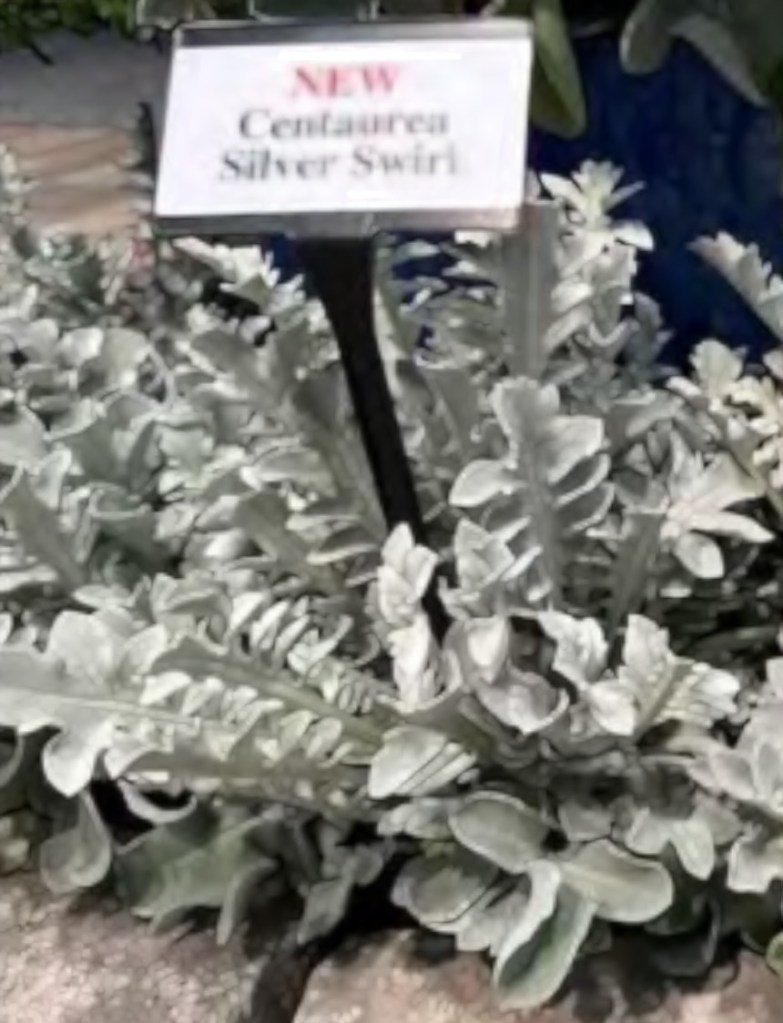
The new cultivar originated in a controlled breeding program in Hem, The Netherlands during September 2016. The objective of the breeding program was the development of Centaurea cultivars having good winter hardiness and a mounded growth habit suitable for borders and container plantings.
The new Centaurea cultivar is the result of open-pollination. The female (seed) parent of the new cultivar is the proprietary Centaurea ragusina breeding selection coded A14, not patented, characterized by its bright, yellow-colored flowers, light silvery, greyed-green colored foliage, and moderately vigorous, mounded growth habit. The male (pollen) parent of the new cultivar is unknown. The new cultivar was discovered and selected as a single flowering plant within the progeny of the above stated open-pollination during August 2017 in a controlled environment in Hem, The Netherlands.
Asexual reproduction of the new cultivar by terminal stem cuttings since August 2017 in Hem, The Netherlands and Elburn, Illinois has demonstrated that the new cultivar reproduces true to type with all of the characteristics, as herein described, firmly fixed and retained through successive generations of such asexual propagation.
As I have noted, that there seem to be various clones of C. ragusina in the trade, as well as in its native distribution. It would make sense that some clones might be more cold hardy than others, the the Adriatic coastline (where this species is native) can have extreme weather.
If you live in a cold winter climate, it MIGHT be worth checking out this cultivar (though depending upon the source, it might be hard to be sure that you are being offered a true clone the plant that is cold hardy as Centaurea ragusina ‘Balcentsirl’.
Regardless, I am happy to see this interesting and handsome plant re-enter our horticultural trade! I still grow the plants provided to me by my friend in France, now mostly seedlings of the original plant. I have spread it among friends and family who expressed interest and they regularly tell me about their success in growing this mediterranean climate plant.
Resources & Links
(*Information retrieval date for the URL mentioned)
Mr. Kovac’s dusty miller PART I, Mr. Kovac’s dusty miller PART II
Centaurea ragusina (a page on this blog)
Seaside Gardens, Carpinteria, www.seaside-gardens.com/, (*February 2024)
Centaurea ragusina, San Marcos Growers, www.smgrowers.com/products/plants/plantdisplay.asp?plant_id=4195, (*January 2024)
Cenatuarea ragusina, Snowflake Dusty Miller, Waterwise Botanicals, nebula.wsimg.com/f2696660c9c2a91db81ced1281018e6c?AccessKeyId=824BAA379A1712A921FC, (*December 2014)
Centaurea ragusina ‘Balcentsirl’, Justia Patents, Ball Horticultural Company, https://patents.justia.com/patent/PP35838, (*September 2023)
 gardening in mediterranean climates worldwide