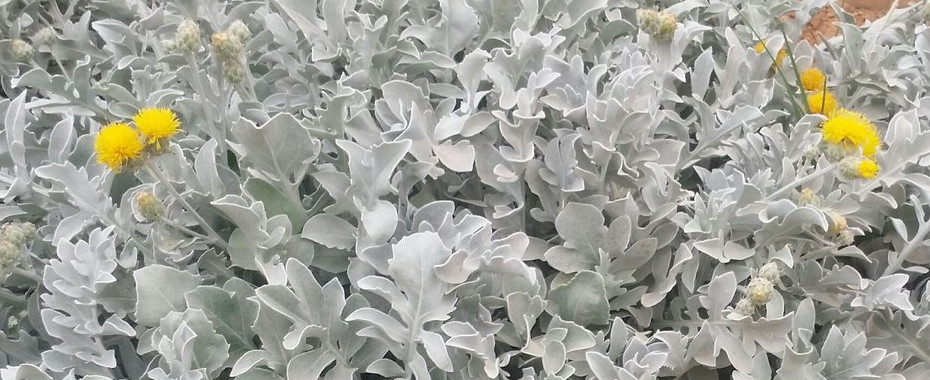
I have an interesting history with this plant which seemed to set me on a path to learn about other, similar species. If you like stories, you can find out more here – Mr. Kovac’s dusty miller (in three parts).
I also have put together a page of various Centaureas that have been confused with this species in various books of the last 100+ years. That confusion has been transferred to today’s Internet, so it seemed worthwhile to try and help sort things out.
History buffs might immediately pick up on the specific epithet ragusina, which refers to the Republic of Ragusa (1358-1808), Dalmatia, which was centered in today’s Dubrovnik in southern Croatia (not to be confused a province called Ragusa in Sicily, Italy). ‘Ragusina‘ is very appropriate as this grows on cliffs facing the Adriatic Sea, the region in which this famous maritime empire operated.
One of the earliest mentions I have found for this species if in William Curtis’ The Botanical Magazine, Vol XIV, 1799, which states that it is native to ‘Candia’, a Venetian word for Today’s island of Crete. Interestingly, there is a different species of Centaurea native to Crete – C. argentea – looks similar. I wonder if the ‘Candia’ reference may have inspired the leap to candidissima, a common specific epithet meaning ‘white’, that has been erroneous assigned to this species.
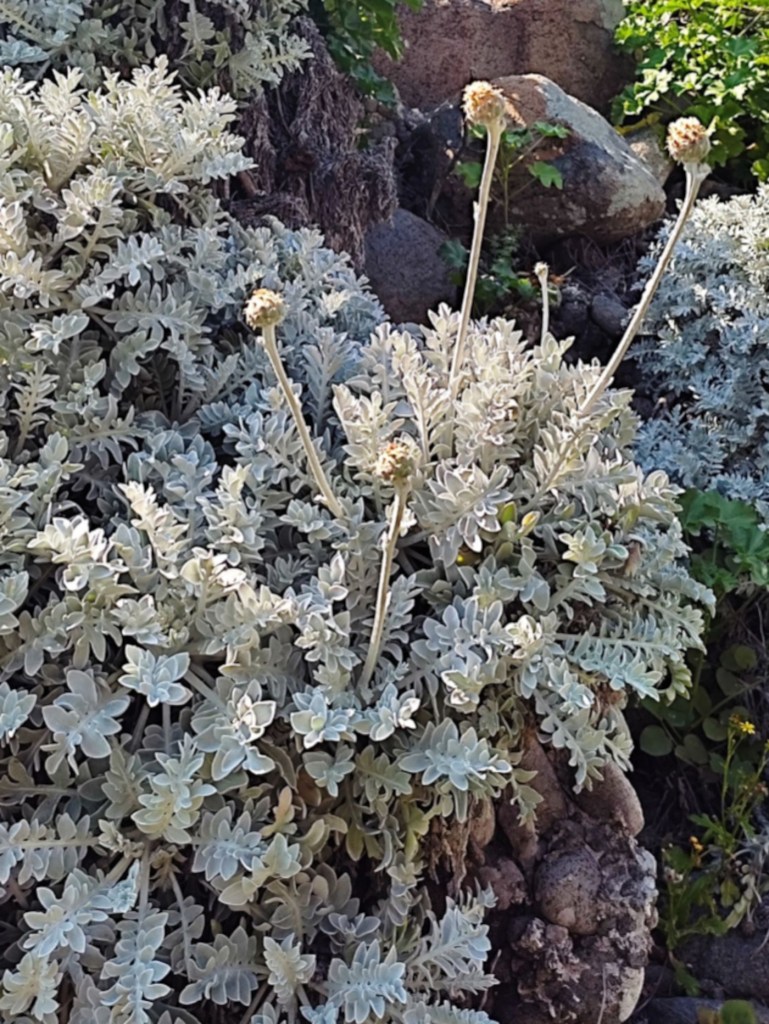
The bright white or gray color of the leaves comes from dense, fine hairs that help protect the plant from intense sunlight and excessive evaporation – perfect from growing on rocks and cliffs adjacent to the reflective waters of the Adriatic! This adaptation is called ‘xeromorphic’ (xero: dry; morphic: their shape or structure) and is used to describe many plants that have evolved to live in such hard conditions.
Somewhat tolerant of various soil types, C. ragusina grows best in poor, rocky soils with a high PH (alkaline) and good drainage. In richer soils, it can be relatively short lived, growing too quickly, ‘exhausting’ itself in a few years. Many soils here in California are fairly rich, and gardeners routinely amend heavy clay – this may have led to this plant being considered a ‘short-lived perennial’. Growing on vertical limestone cliffs in its native habitat explains why a friend has had great success with growing C. ragusina at the top of a concrete wall!
Propagation by cuttings is easy (as explained in my story mentioned above), and seed can also easy if you can protect the heads from local birds! I once found the floral stem of a potted specimen bent down over another an adjacent pot – the seeds escaped notice of the birds so there were numerous seedlings sprouting in this neighboring pot.
Our daughter has also reported that this is among the few plants deer don’t usually browse, presumably because of the felty foliage (but you never know with out local SF Bay Area deer!)
A Brief Botany Break
Centaurea ragusina L. – Suppl. Pl. 2: 912. (1753)
ken-TAR-ee-ah raw-GOO-sin-ah (pronunciation info)
Distribution
Central and southern Dalmatian coast of Croatia, specifically on islands and mainland cliffs, rocks, and stone walls (including old buildings). I’ve seen various data showing this species occurring in random other countries far outside of the above – perhaps these represent escapes from horticulture? There does seem to be occasional occurrences on the Adriatic coast of Italy, directly across from Croatia, which seem more likely to have been ‘natural’.
Synonyms
Colymbada ragusina (L.) Holub – Folia Geobot. Phytotax. 7(3): 316 (1972)
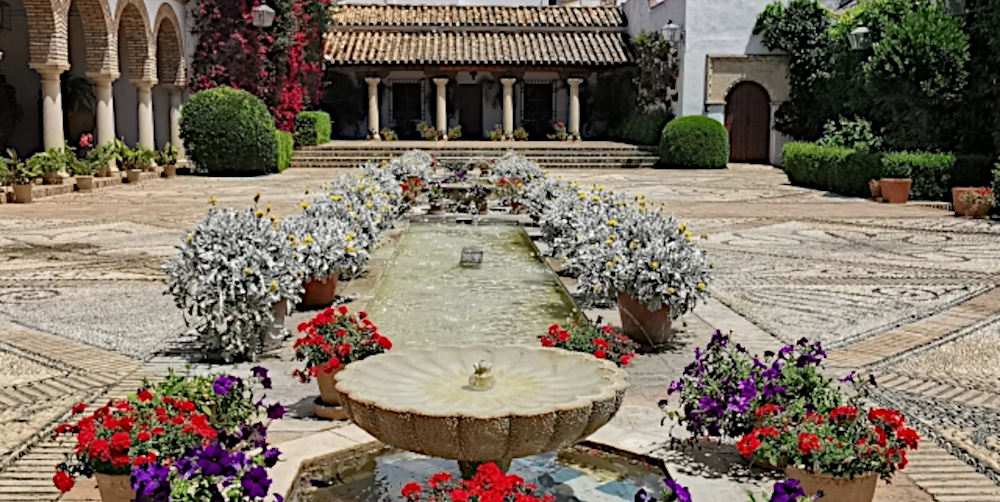
A famous garden that features C. ragusina is Palacio de Viana, Córdoba, Spain. Potted specimens have been historically arranged in its various courtyard, attracting much attention for their unusual foliage (see Mr. Kovac’s dusty miller, Part II), even though their correct botanical name is not usually identified.
Since I first wrote about this plant 20 years ago, I have found a few nurseries starting to offer C. ragusina again. I am sure that San Marcos Growers – a large wholesale nursery in southern California – adding it to their inventory also helped! (see Mr Kovac’s dusty miller, Part III). Unfortunately, it can still be found on the internet under the misapplied name of C. cineraria.
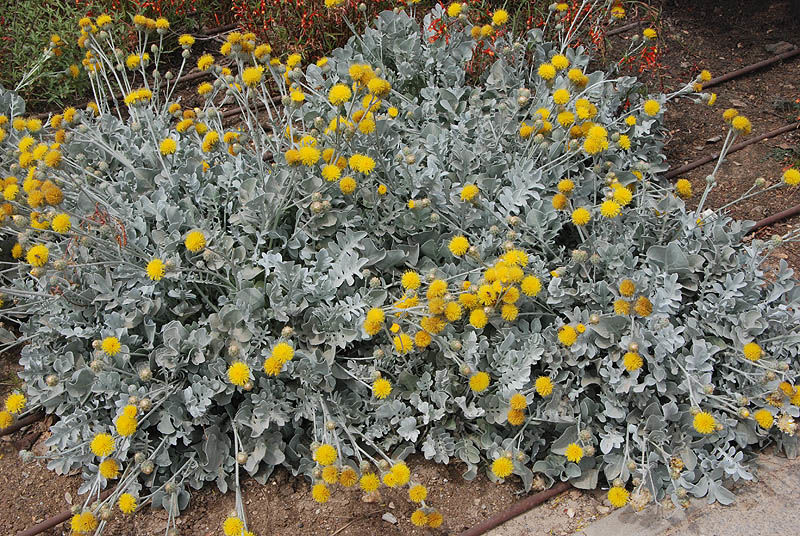
Part of the resurgence of this species has been to ‘introduce’ new named cultivars to set it apart from the species. Analyzing the information about these new cultivars, e.g. ‘Silver Swirl‘, ‘Snowy Owl‘, might have been selected for certain qualities, but they are fairly close to the species. Regardless, it is nice to see this species receiving attention again after so many years!
Addendum
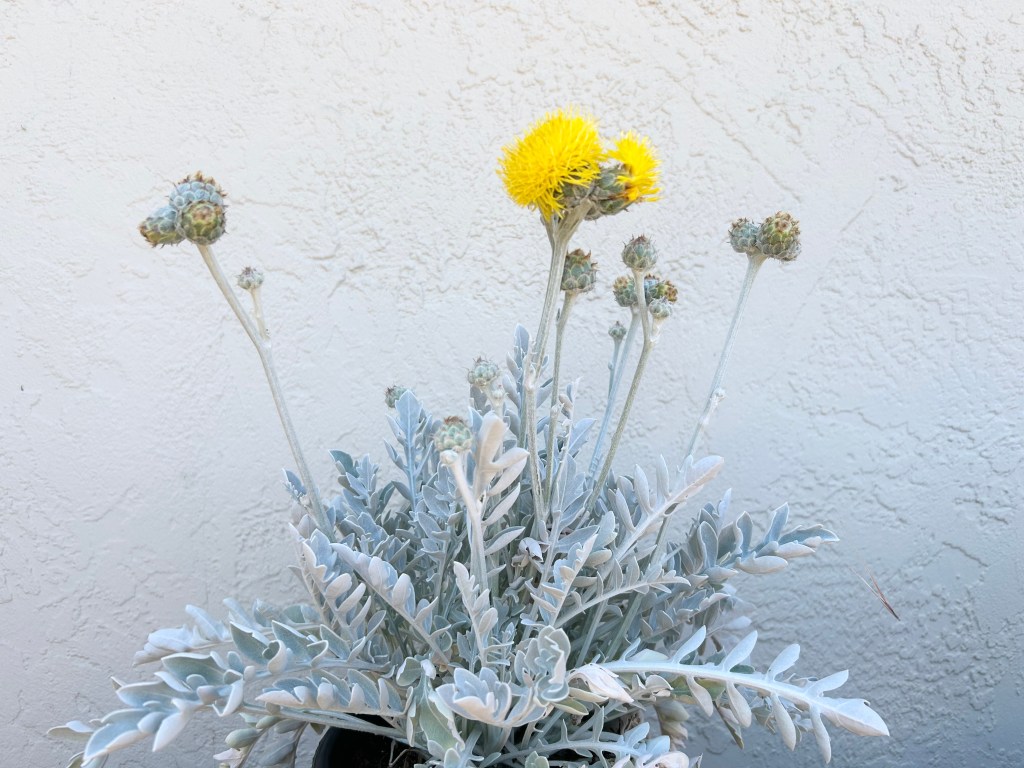
I have found a plant of C. ragusina ‘Silver Swirl’ and am evaluating it with regards to the straight C. ragusina species I have known for decades. It certainly looks different from the plants I am growing currently, reminding me of a form a Facebook friend in the Italian Riviera shared with me a number of years ago. Looks promising. The form is more compact, the leaves are more ‘feathery’ (divided), and it seems happy to produce many flower stems! Worth a cultivar status, so you have my endorsement!
Resources & Links
(*Information retrieval date for the URL mentioned)
Mr. Kovac’s dusty miller PART I, Mr. Kovac’s dusty miller PART II, Mr. Kovac’s dusty miller – Part III (all are posts to this blog)
Comparitive Centaureas (a post on this blog), gimcw.org/2014/07/25/comparitive-centaureas/
Centaurea ragusina, San Marcos Growers, www.smgrowers.com/products/plants/plantdisplay.asp?plant_id=4195 (*January 2025)
Centaurea ragusina ‘Silver Swirl’, Proven Winners, www.provenwinners.com/plants/centaurea/silver-swirl-snowflake-dusty-miller-centaurea-ragusina (*April 2025)
Centaurea ragusina ‘Snowy Owl’, Forestfarm, www.forestfarm.com/centaurea-ragusina-snowy-owl-cera012.html (*April 2025)
Cenaturea ragusina L., Flora Croatica Database, hirc.botanic.hr/fcd/DetaljiFrame.aspx?IdVrste=12845 (*March 2025)
The Republic of Ragusa, (1358-1808), Dalmatia, https://en.wikipedia.org/wiki/Republic_of_Ragusa (*March 2025)
 gardening in mediterranean climates worldwide